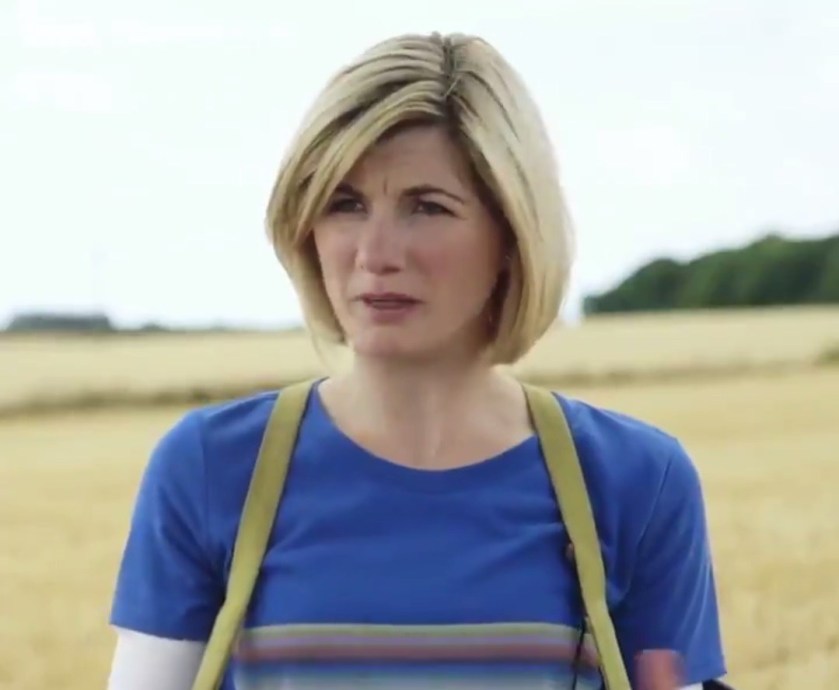
With Doctor Who’s 12th Season behind us, can we finally end the debate on how well a female Doctor lived up to our expectations?
For Jodie Whitaker as the 13th Doctor, her performance should prove that ‘anyone’ can play the Doctor, but critics have decried her lack of an “innermost life of moral conflict” and that she is missing the “heavy metal” potential of the Doctor’s terrifying powers to give us the good morally obscure scare that we crave.
From an anthropological perspective, I might agree. However, I have found far more revelations when shifting my focus to a Time Lord’s perspective…
Despite her overall age as a Time Lord, the 13th Doctor was reborn in what I would consider the bubbly life of a young woman–do not take this for granted! The challenges of today’s achievement based society can easily lead to burnout, resulting in a ‘crack in the wall’ on one’s optimistic outlook. I laughed out loud when I read an article on how women in their 30’s shouldn’t take it personally to find women in their 20’s displaying bubbly hope, relentless cheerfulness, and carrying the charismatic glow that their goals and dreams haven’t yet been altered by the evil seamstress of experience and time. As Time’s greatest defender, I have at least a baseline level of respect that the Doctor hasn’t yet worn him/herself out, and still has the drive and energy to banish the newest villains of the season, including hoards of giant hairy spiders.
Secondly, I do wonder what it would be like to skip the long process of gender reorientation and find oneself immediately implanted in a body requiring instant personal and social adaptations. After being a male for so many centuries, our avid explorer and student of the universe might have felt bored. The 13th Doctor probably found it exciting to wake up to such a radical alteration. Perhaps even, the gender change is what wiped out the inner moral turmoil that we now seem to miss—the psychic turmoil of questioning ‘Am I good?’ that had been swelling from Matt Smith to Peter Capaldi, or the self-doubt and loss of friendships that had become a burden. The 13th She-Doctor has been a chance to start over, to adopt the cheerful mindset of the beginner and live in the moment.
Third, as a female, the Doctor will now be exposed to many for biases and discrimination—and is probably taking a greater interest in social and political issues. I admit that I did feel uncomfortable watching the 13th Doctor take a subordinate role in “The Witchfinder”, and I was disappointed to see that the Doctor could do nothing against racism in real time during the Rosa Parks episode, but these were intentional effects to convey history. The focus on issues of sexism and racism felt edgy, but also a bit cringe-worthy, like hearing the “F” word for the first time on Star Trek “Discovery”. No, we don’t want to entrench ourselves in identity politics, but if it’s important to the Doctor, maybe it should important to us too. Lest we forget the larger lesson, the season made the case that it’s important to stand as a witness for history and changing times. Regardless, even if the goal is to cause us to reflect on where we are at as society, it still probably won’t change our fascination with posting one’s favorite doctor and rankings of companions on social media.
Fourth, we have no idea what female role models existed in the Time Lord history books that she is now trying to live up to. For all we know, the Time Lords could have also struggled to define worthy female hero archetypes. If she looks to humanity for an example, there are heroes, but they often come with confusingly poor reviews, like Rey in The Last Jedi. If I could offer her with a role model—it would be Captain Janeway from Star Trek’s Voyager, especially after the episode Macrocosm where she achieves beast-mode akin to G.I. Jane.
Finally, there’s the complaints about the interior decorating of the TARDIS. But in reality, the working world was built for men, from workplace air conditioning settings adapted to the baseline of male body temperatures, to having to travel further to access a place to pee for women in places from Congress to jobs in cable repair (thereby reducing the time ‘on the clock’ and reducing reliability and pay). So shouldn’t we expect that a female doctor would institute a radical redesign?
Responding to the critics:
Do we really want a more terrifying female Doctor, with inner turmoil and the weight of the universe on her shoulders? I acknowledge the ever-present gender-specific risk: we don’t want our first female doctor to fail by seeming emotionally detached.
Perhaps we could provide challenges that inspire awe in her powers; place temporary limitations on her to highlight the sweat on her brow while she’s making decisions for the whole universe (and perhaps they could make the temporary loss of a sonic wand or the TARDIS not seem like such a small inconvenience). From my recommendation, the character Captain Janeway always kept herself at a professional distance from her crew while the audience remained privileged to observe her inner moral turmoil. We got to watch her decisions and admire her confidence, all in spite of having to put her crew into harm’s way. Limitations sometimes define the hero. Another example, in Wonder Woman (2017)–before we had discovered her full-fledged demigod powers, and when it seemed like she had lost faith in humanity, we felt the doom of her impending defeat and the risk of us all ending up in a real version of Man in the High Castle. Weaknesses are often necessary to make a story interesting.
Our challenge–in accepting a female Doctor–may be a result of not being able to distinguish her newly formed female weaknesses from the tried-and-true weaknesses of the male predecessors. We expect there to be different weaknesses between genders. And developing a strong story for a character takes time. Prior the cinematic release of Wonder Woman, the authors spent years crafting a wide range of weaknesses that would put us on the edge of our seats. For some, our 13th Doctor may always feel like the cut-and-paste Ghost Busters effect.
Without a backstory providing more context for female-specific challenges that we can accept, I can think of only two suggestions: Either go back to the first doctor’s character and have the next female Doctor be a grandma with her grandson, or remove the toilet from the TARDIS and see if Jodie can make it to the next catastrophe on time.
Maybe it’s best to give #13 the benefit of the doubt that she is having the time of her life as a newly emerged woman and accept the jovial brilliance of her performance. Perhaps it is also good that the show won’t continue until 2020, giving us a chance to improve our hindsight and develop some more reasonable expectations for our beloved Doctor Who.
But if I could make one last unimportant point: with the fashion trends going away from leisurewear, Season 12 just might consider an upgrade to Jodie Whittaker’s costume to add a sense of professional power.
 Waunder