Fortunately, our land-lady left us with one of those black dome-shaped composting bins. Clearly, the last tenants had tried to use it, but had clearly failed based on how much debris (and trash–and soot!?) was left in the area around the bin.
Determined to use it, I bought a small, clean, and white kitchen bin–the type with a lid that can be opened from bush-button to keep the hands clean. Inside was a small black pale with a small metal handle to carry it out to the garden.
This small pale absolutely didn’t work for me for two reasons: The pale was so small that it would need to be taken out every 1-2 days. And second, I didn’t want to take the pale out every 1-2 days.
What I needed to develop was a system of habits, usually called habit-stacking because one habit leads to another, making each of the habits easier to do.
You would think that taking it out more frequently would establish a better habit system than taking it out less frequently. However, I didn’t have enough knowledge about composting as a system, so we ended up throwing most of it out in the Bio bin (the German trash bin for compostable materials). *Spoiler alert: The more I learned about composting, the small pale didn’t help me to visualize how much brown I needed to add to maintain the 1:4 green to brown ratio.*
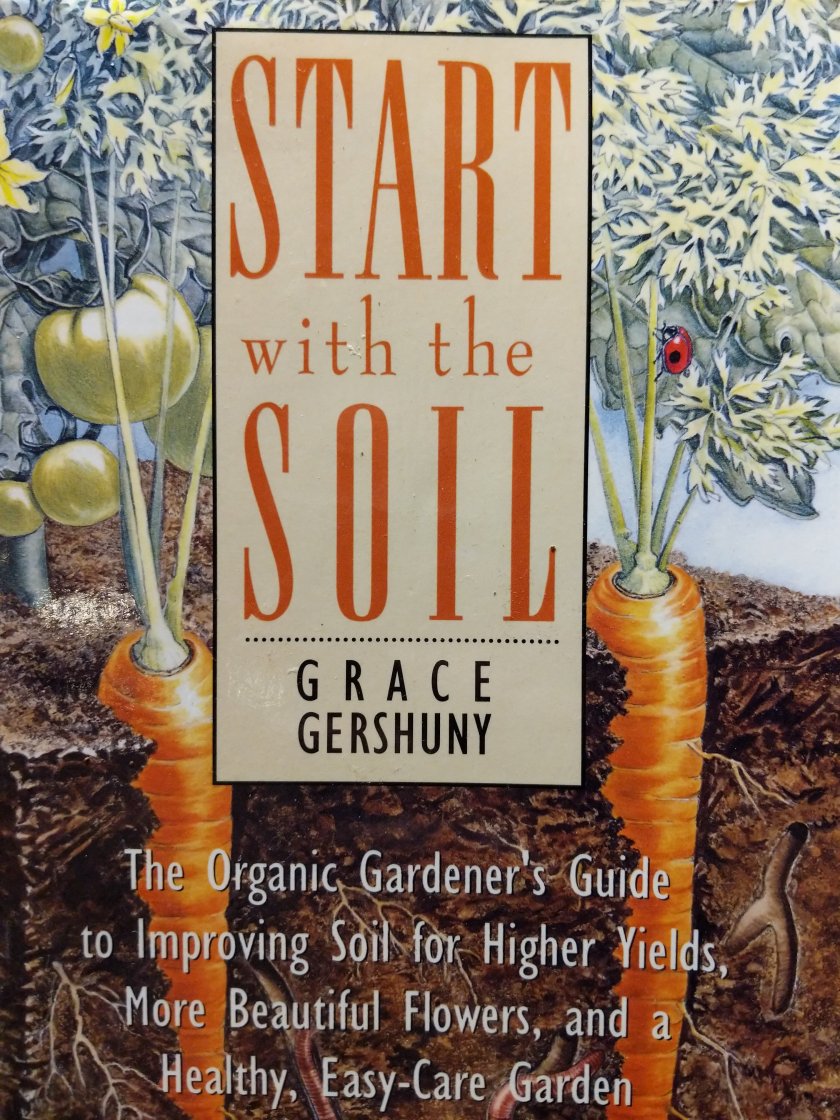
In the book “Start with the Soil” by Grace Gershuny (with links to purchase below), I learned that composting isn’t just a method of creating more soil, it’s a vital process of maintaining bacteria, fungus, and worms. A compost tea can potentially help plants to resist disease and even ward off mildew, something I will be closely tracking this Spring.
The book also gave me a specific goal: improve the ratio of green to brown to raise the temperature of decomposition to 120-170 deg F. After 4 months of developing my composting system of habits, I was delighted to open my composting bin and feel the waves of heat rising from the pile while the air outside was 0 degrees.
With the small pale, my first concern had been focusing on feeding the bin with food scraps. As I learned more, my greater concern became filling it with enough carbon, and realizing that I didn’t have enough carbon available on my plot.
Having enough carbon is critical for building up the humus, but it can be difficult if you don’t have enough trees with fallen leaves, and things like cardboard can take longer to decompose.
This is when I got into rabbitry. Rabbits eat Timothy hay for food and need a lot of straw for their bedding. Both hay and straw have a very high carbon to nitrogen ratio of 80:1, which is significantly higher than the other sources of carbon in my yard such as leaves having a 50:1 ratio.
By the time I was taking care of 4 rabbits, I found that I had more than enough hay to keep the carbon ratios high, but I also discovered the value of rabbit manure. When I sprinkled the manure throughout the garden, the worms quickly went to work, leaving huge castings in piles scattered around the yard. Adding the bedding of hay and manure became an easy to way to improve the composting process even more.
With an arsenal of carbon, the next step is to add sufficient nitrogen so that the pile will heat up. The common sources of nitrogen in my yard include freshly cut grass, young weeds, and vegetable wastes (the rabbit manure is also great).
The next step was to replace the tiny composting pale in my kitchen with a normal sized pale that could hold more scraps.
The ideal ratio of carbon to nitrogen is 20-30 carbon to 1 nitrogen. Most of the food scraps that we produce usually provide ratios of 12:1 to 20:1. Doing some rough math with fractions, I found the difference between my desired ratio (1/30) and the scraps (1/12) was 1/18. Then I calculated how much hay (1/80) I needed to compensate for that difference.
Step 1: 1/12 + 1/80*X = 1/30.
Step 2: 1/80*X = 1/30 – 1/12
Step 3: 1/80*X = 1/18
Step 4: X = 1/18 * 80/1
Step 5: X = 80/18 = 4.5
Step 6: Define the result as 1 pale of scraps balanced by 4.5 times the amount of hay
Because the ratio should be as low as 1/20, I also re-did the calculation to find that I would need 10 times the amount of hay to scraps.
This is where the larger pale came in handy. When dumping the pale into the bin, I could visualize the size of the pale, and roughly estimate how much hay to add, which was 4-10 times the size of the pale.
Now, when I weed the yard, I collect them in a similarly sized pale to help me visualize the amount of carbon to add.
The final step in my habit system is to grow vegetables with sources of nitrogen, which mostly come from leguminous plants such as alfalfa, beans, and peas. As I plan the garden layout for Spring, I’m focusing on bush beans, pole beans, and peas, but I will also be growing many other common vegetables and fruits.
Growing food as a final step is important to me because it creates a circular energy system rather than a one-way in and out from remote production centers to the dump. This will decrease how much I buy from the store, but in using compost, it also reduces the amount of chemicals and pesticides that are used to grow food.
The compost breaks down organic matter and produces a plethora of beneficial bacteria, reducing the need to bring in soil amendments and fertilizers. But even for the food that I do bring in from the store, I’m able to put it to good use in improving that garden rather than sending it off as waste.
The final step that I’ve had to add to my habit system is to stir it once a week. Using a pitchfork to turn it over mixes the ratios of carbon to nitrogen and provides airflow for the bacteria to do its work. I’ve found a shaded spot to leave a pitch-fork so that I have no lazy excuse not to pick it up.
Amazingly, the process becomes easier and easier because using the hay makes the composition lighter and easier to turn.
It just goes to show that “if you give a mouse a cookie…” –wait, that’s a different story to tell. Rabbits, anyone?
 Waunder