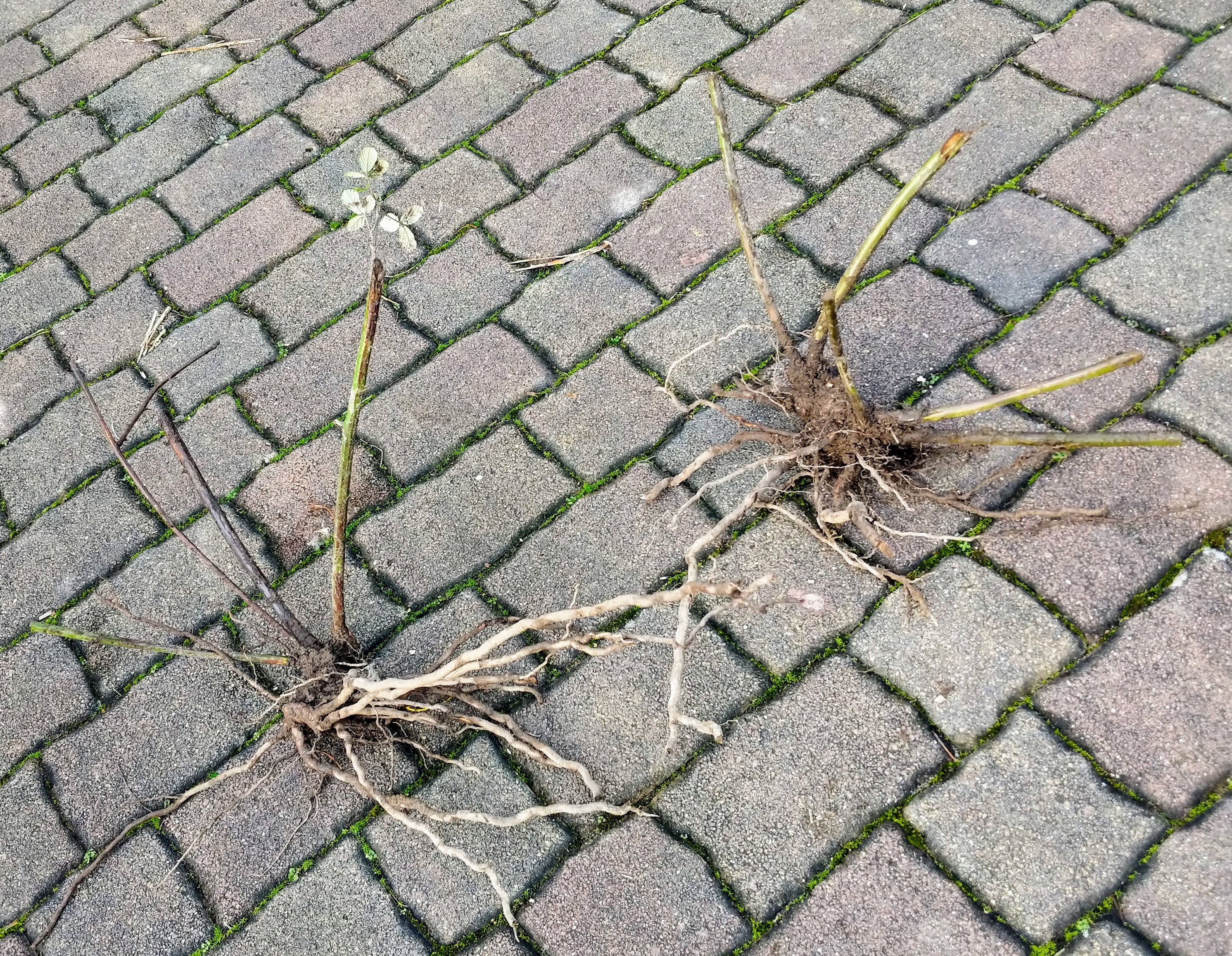
Himalayan Blackberry bush – or another name by which I like to call it – The Great Bramble.
In my rural village in the Rhineland Palatinate of Germany, it seems the entire neighborhood has been taken up by these giant sprawling brambles. While they do produce a multitude of blackberries for the birds (and people) to feast upon, they can grow many meters in length in every direction during the growing season, choking out many other plants, and are very prickly to the touch.
When I tried to eradicate them from my yard, I spent several weekends break a shovel, bending pitchfork tines beneath the roots to pull them up, and nearly breaking my back. I finally bought a miner’s pickaxe from the hardware store to dig faster into the earth and chop up the roots.
This was the first time that I really understood the importance of the root ball, shown above.
Everywhere I stepped, another root ball seemed to form, spreading a dozen roots in every direction while half a dozen shoots growing out the top.
At first, I thought it was spreading by rhizomes underground. However, the roots did not travel as fast as the shoots which sometimes leaped several meters through the air last Spring.
Instead, I found shoots who would arch their path over the grass, dipping the tip to the earth to find a new rooting spot.
This is called Tip Layering, where the branch tip roots where it touches the ground.
After pulling up roughly 20 root balls, I found that one of them was a different plant. It’s root ball was wound up like those purchased from the store. I realized that I had found a plant put there by previous owners who failed to pull the roots apart so that it wouldn’t continue to follow the circular path it had in the pot since birth.
And while I do not yet know if the bramble till grow back from un-tilled roots, at least the main hubs – the brains – the root balls, will hopefully slow them down.
While I may be annoyed at the blackberry brambles, they at least showed how a vigorous (and invasive!) root system can quickly take over if the roots are widely spread.
 Waunder